


London, England (CNN) -- English archaeologists said Friday they are trying to figure out why 97 babies were buried around a Roman-era villa that may have been used as a brothel.
Because childbirth in Roman times was more dangerous than it is today, infant mortality was high and infant burials are common at Roman villas. However, the massive number found at the site in Buckinghamshire, just northwest of London, is far higher than at any other Roman villa in Britain, the Buckinghamshire County Council said.
Recent examination of the Roman-era bodies shows "the infants almost all died around the time of birth, suggesting this may be an example of deliberate infanticide," the council said.
That was legal in Roman times if the mother was a slave, and a large number of deliberately killed babies may show someone wanted to keep the mothers working, it said.
The villa was occupied for several hundred years during the Roman era, and there is a theory it may have been used as a brothel, which would explain the high number of unwanted babies, the council said.
There is also a theory that the building was an imperial supply depot with many literate workers, since a large number of writing implements were found at the site, along with a high number of kilns for drying corn. If those literate workers were mostly women, they may have been forced to kill their babies and keep working, the council said.
Yewden Villa, as the site is known, was first excavated in 1912. It was later covered over and is now a field. The report on the dig didn't appear until 1921 because World War I got in the way, the council said.
A community archaeology project recently started looking at the 1912 finds, most of which had never been examined, hoping a century's worth of new research may shed new light on them, the council said.
The 1921 report, which was published in the national journal Archaeologia, described the grounds as "positively littered with babies."
"A few were laid at length, but the majority were evidently carried and buried wrapped in a cloth or garment, huddled in a little bundle, so that the head was almost central, and the knees above it," the report said.
"As nothing marked the position of these tiny graves, a second little corpse was sometimes deposited on one already in occupation of a spot, apparently showing that these interments took place secretly, after dark."
Most academics agree that large Roman villas were built and used by a small but extremely wealthy section of the society that lived in the area between the first and fourth centuries AD, the council said.
They were used as both residences and administrative and servicing centers, it said.
Adults had to be buried outside a settlement when they died, but that rule did not apply to infants, the council said.
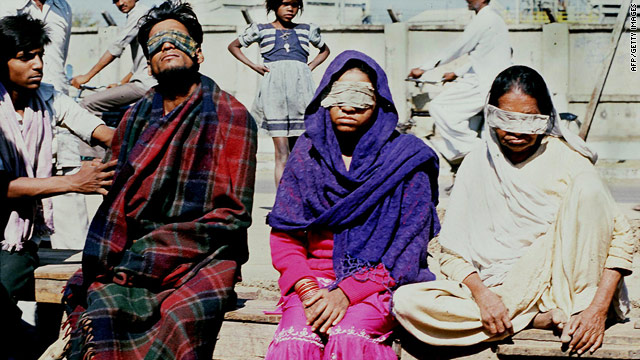
New Delhi, India (CNN) -- India has announced a new financial package for victims of the 1984 Bhopal gas disaster as the case shot back to prominence after a court ruling this month.
The country's Cabinet has sanctioned about $270 million as part of plans to compensate the victims and clean up what is now a defunct plant of Union Carbide India Limited (UCIL) in the central city of Bhopal, authorities said.
Information and broadcasting minister Ambika Soni told reporters Thursday that the new financial assistance would be delivered to more than 45,000 people deemed severely hit by the leak of poisonous gas from the pesticide factory 26 years ago.
Deaths, disabilities, cancer and total renal failures from the exposure will be covered under the package, she said.
Nearly 4,000 people died in the immediate aftermath of the escape of methyl isocyanate, a chemical used to produce pesticides, from the company's plant in Bhopal in December 1984. More than 10,000 other deaths have been blamed on related illnesses, with adverse health effects reported in hundreds of thousands of survivors.
Many of them struggle with ailments including shortness of breath, cancer, near-blindness, fatigue and heart problems.
Soni's announcement came barely two weeks after a court in Bhopal handed down a two-year sentence to seven Indian executives of the local subsidiary of the US-based Union Carbide Corp. (UCC)
The ruling sparked an outcry in India, with both government and judiciary coming under heavy criticism for their handling of what has been regarded as one of the world's worst industrial disasters.
Originally, the Indian defendants were tried on the count of culpable homicide. After an appeal, the country's supreme court downgraded the charges to death by negligence in 1996. Soni said the top court would now be petitioned again to revisit its 1996 scrapping of tougher charges.
As advised by a ministerial panel this week, India will also push the United States to extradite Warren Anderson, the former head of Union Carbide Corp., she said.
Anderson has been declared a fugitive from the Bhopal indictment in India, with an arrest warrant out for him.
Indian authorities, officials say, will use new evidence in support of the extradition plea: testimonies that the parent company was aware of what investigators believe were defects in its Bhopal plant.
India's federal police first requested that the United States extradite Anderson in 1993.
"However, this request remains unexecuted," the Central Bureau of Investigation noted in its statement on June 7, the day of the Bhopal ruling.
Currently, India has extradition pacts with 31 countries, including the United States.
Investigators have blamed the Bhopal tragedy on the maintenance and design of the site.
Union Carbide, however, said the leak was an act of sabotage by an employee who it said had tampered with the gas tank.
The company, now a subsidiary of Dow Chemical Co., paid a $470 million settlement to India in 1989.
But the International Campaign for Justice in Bhopal said survivors had so far received an average of only $500 each in compensation.
Union Carbide says neither the parent company nor its officials are subject to the jurisdiction of Indian courts.
Sixteen years after the leak, Union Carbide became part of the Dow Chemical Corp. Union Carbide claims the issue has been resolved and Dow has no responsibility for the leak.
In her briefing, however, Soni said the government would pursue courts dealing with liability litigations.
"Appropriate applications may be filed before the courts concerned and request the courts ... to expeditiously decide the question of liability of the Dow Chemical company and/or any other successor to UCC, UCIL," she said.
Also, India's Cabinet recommended the country's attorney general examine the possibility of approaching the top court again for reconsideration of the 1989 settlement of $470 million.
(CNN) -- The recent change in commanders in Afghanistan is proof the U.S and its allies have lost the war, statements posted on two Islamist websites said Thursday.
Taliban spokesman Qari Mohammad Yousif Ahmadi said in one statement President Barack Obama wanted to save face by firing Gen. Stanley McChrystal and bringing in Gen. David Petraeus. McChrystal was relieved of duty -- although he technically resigned -- Wednesday after he and his staff made comments in a Rolling Stone magazine article that appear to mock top civilian officials, including the vice president.
"History is evident of more powerful and experienced generals than General McChrystal and empires mightier than the United States of America being surrendered and bowed down before the Afghans," Ahmadi said, according to the website statement.
Ahmadi said McChrystal's strategy of increasing the number of troops in Afghanistan had been futile and led to the change in commanders. The Taliban spokesman said the change in command is useless because Petraeus, the new Afghan commander, is weak.
"Indeed, he has got no (more) special qualities than General McChrystal had," Ahmadi said in his statement.
In another statement, a group calling itself the Islamic Emirate of Afghanistan said Petraeus is mentally worn out because of the lengthy war, which began in October 2001.
"Nine years of military actions, different strategies and back-breaking monetary and life damages at the hands of mujahedeen have left the crusaders totally in distress," the statement said.
Last week, when Petraeus briefly fainted at a Senate Armed Services Committee meeting, dehydration was cited as the cause. But the website said it was a sign that Petraeus knows the war in Afghanistan is lost.
"General Petraeus, being witness to the incidents in Afghanistan is the only person who realizes the gravity of (the) situation and described this situation well by falling unconscious," the Islamic Emirate of Afghanistan said.
"Through this action he gave the answer to many questions to which the members of committee were eager to listen. They should learn from this answer by General Petraeus and start working for the well being of their masses."
Ahmadi, in his statement, said Petraeus has "left a big question mark on his physical and mental health."
