

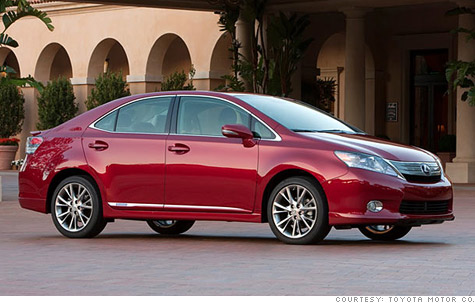
NEW YORK (CNNMoney.com) -- Toyota is recalling 17,000 Lexus vehicles because they spilled too much gasoline during crash tests, the company said Friday.
The affected vehicles are 2010 model year Lexus HS 250h cars, Toyota said. The company did not immediately return a request for comment.
As part of a yearly testing program, the National Highway Traffic Safety Administration (NHTSA) performed a crash test and found that these cars spilled more gasoline than is allowed by the agency's safety requirements.
But Toyota said it tested the cars in the same manner and found that the fuel spillage met the requirements. The company is working to identify the reason for the different test results.
Lexus has not yet identified a fix for the problem, "but it is working hard to do so promptly and will notify owners as soon as one is developed," the company said in a statement.
Federal law prohibits dealers from selling any of the recalled products until a fix is identified.
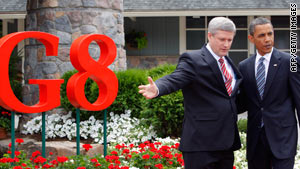
Toronto, Ontario (CNN) -- President Obama arrived in Ontario on Friday for a series of high-stakes economic meetings with leaders from around the world.
Obama, who was greeted in Toronto by America's ambassador to Canada, David Jacobson, is set to meet first with his counterparts in the G-8 nations, followed a broader G-20 summit over the weekend.
The meetings are taking place against a backdrop of continued economic uncertainty, with demands for more government stimulus balanced against fears of runaway deficits. At home, the Obama administration is struggling to push a new economic relief package through an increasingly skittish, debt-wary Congress. Overseas -- particularly in Europe -- leaders are increasingly being forced to enact unpopular fiscal austerity measures.
Also hovering over this weekend's meetings is the specter of protests and violence, which have plagued other recent meetings of world economic leaders.
Friday morning, before departing the White House, Obama referred to agreements reached in the first two G-20 summits he attended and added, "This weekend in Toronto, I hope we can build on this progress by coordinating our efforts to promote economic growth, to pursue financial reform, and to strengthen the global economy.
"We need to act in concert for a simple reason: This (recent economic) crisis proved and events continue to affirm that our national economies are inextricably linked -- and just as economic turmoil in one place can quickly spread to another, safeguards in each of our nations can help protect all nations."
Obama fears that a rollback too soon from government stimulus packages would send the world back into recession. The European Union, on the other hand, has sent a letter to all G-20 leaders asking for substantial budget cuts to come no later than 2011.
Also high on the agenda will be reforms to global banking regulations. Although all G-20 nations have pledged banking reforms, the reforms being considered in Europe and North America are diverging. Britain, France and Germany are calling for taxes on banks to pay down deficits and cushion future financial shocks. The U.S. government wants to discourage additional taxes, which officials fear would stunt consumer demand.
The weekend's sessions will offer a first appearance on the world stage for British Prime Minister David Cameron and Japanese Prime Minister Naoto Kan. Both leaders arrived in Toronto on Thursday.
The G-8 meeting opens Friday at Deerhurst Resort in the Muskoka region of Ontario. The G-20 meeting opens Saturday in Toronto.
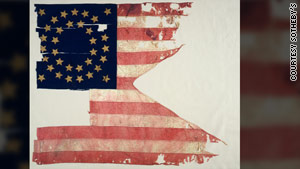
New York (CNN) -- A flag that accompanied Lt. Col. George Armstrong Custer and his 7th Cavalry into their final battle 134 years ago will be put up for auction, the auction house that will handle the sale said Friday.
Custer led more than 200 other other soldiers into battle against thousands of Lakota and Northern Cheyenne warriors on June 25, 1876, at the Little Bighorn River in what is now Montana. None of the U.S. soldiers survived the battle.
The flag that will be sold in October is tattered and fragile, measures 27½ by 33 inches and may be stained with blood. It was found three days after the Battle of Little Bighorn -- or the Battle of Greasy Grass Creek, as the victors called it -- beneath the body of one of Custer's men killed in the battle.
Sgt. Ferdinand Culbertson, a member of the burial detail assigned to retrieve the remains of the 7th Cavalry, found the Cavalry guidon, or swallow-tail flag, that was used by cavalry companies. The design reduced wind drag as the soldiers advanced.
"It's not a piece of decoration," said Sotheby's vice chairman, David Redden. "It's a sacred relic. People died for this flag. This flag is really important as it symbolizes one of the great and mythological battles in American history."
Another flag from the battle site was found months later in an Indian village seized by U.S. troops and is now owned by the National Park Service, but Redden said it is in very poor condition.
Custer's last battle was part of the United States government's 1876-77 campaign to retake the Black Hills region, ceded in perpetuity by an 1868 treaty to the Lakota. But when gold was discovered in the area, the army was sent to push the aboriginal Americans to a reservation set up for them.
The 7th Cavalry surprised the Lakota and Cheyenne, camped on the river banks, but Custer vastly underestimated their number and was crushed.
Sitting Bull and Crazy Horse were among the Lakota leaders who took part in the battle.
The Detroit Institute for the Arts acquired the flag in 1895 for $54 but has decided to part with it and use the proceeds for future art acquisitions.
The Institute's director, Graham Beal, says the flag won't be missed as it was often on loan to other institutions, most recently at the Little Bighorn Battlefield National Monument in Montana.
"The sale will help with future acquisitions," said Beal. "With the proceeds we will get art for the collection. Even though we are in Detroit, we have one of the great universal collections including Baroque, African and early modern collections. We are right up there with Chicago, Cleveland and Philadelphia.
Author Nathaniel Philbrick, whose book "The Last Stand: Custer, Sitting Bull and the Battle of the Little Big Horn" was released in May, said the significance of shabby flag is enormous.
"It's not only symbolic, but it's also just a terrific artifact," he said. "It's pretty intact and given what it went through, it's amazing."
John Doerner, chief historian at the Little Bighorn Battlefield National Monument, said he believes the flag is stained with the blood of a fallen soldier and that the banner belongs to the American people.
"It was an act of courage and bravery," said Doerner, a 20-year veteran of the National Parks Service.
"To lose the colors was really something that a soldier would give their lives [to prevent]," he said.
Doerner is helping oversee events for the battle's anniversary this weekend at the national monument, where visitors will hear symposiums and view re-enactments. He is hopeful that a benefactor will purchase the flag and loan it to a national museum.
Redden said expectations are good that the Custer flag sale price might exceed Sotheby's $2 million to $5 million estimate, but the hope is that the sale will come close to the $12.3 million paid for a Revolutionary Battle flag in 2006, a record for any military relic at auction.
